
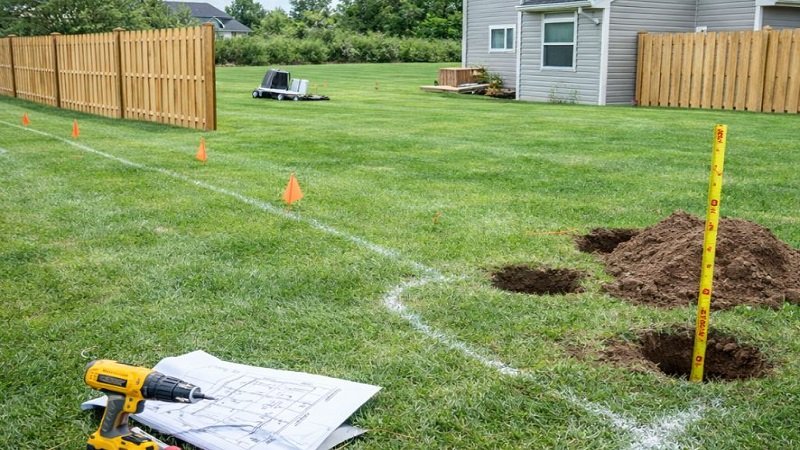
Most fence problems start before the first post goes in. A wrong boundary, a missed by-law limit or a shovel through a buried line costs far more than the fence itself. The order you do things in matters.
This is a planning checklist for a homeowner or a DIY crew. It covers the steps before construction. For the build itself, PrimeAlux has a step-by-step installation guide you can follow once the planning is done.
What should you do before you buy fence panels?
Confirm your boundary, read your city’s fence by-law and decide the fence height and style. Do these in that order, because each one limits the next. Ordering panels first is how people end up with a fence that is too tall or on the wrong line.
Start with a property survey or a reliable boundary marker. If you share the line with a neighbour, talk to them before work starts. Then check the by-law for height limits, corner-lot rules and any pool-related requirements.
Do you need a permit to build a fence in Ontario?
Usually not for an ordinary residential fence, but you still have to follow the by-law. The City of Mississauga says you may not need a permit in most cases, and the City of Toronto’s fence by-law does not require one for ordinary residential fences. Both set maximum heights that depend on where the fence sits on the lot.
Pool enclosures are different. Toronto requires a pool enclosure permit, and other cities have their own pool rules. If your fence is taller than the by-law allows, the usual route is an exemption, not a permit. Rules change, so check the current by-law for your city.
What do you have to do before digging?
Request a locate. Ontario One Call now operates as Ontario Dig Authority, and it states that locates are required for any project that breaks ground, no matter the size or depth. Fence posts count. The locate is free, and you request it through the Request a Locate link on the Ontario Dig Authority website.
Submit the request at least 5 business days before you plan to dig, then wait until the utilities have responded and the marks are on the ground. Digging without a locate can bring a fine and leaves you responsible for any damage.
Public utility locates may not cover privately owned buried lines, such as the supply to a detached garage, a pool, landscape lighting or irrigation. If you or a previous owner installed any of these, consider hiring a private locator.
How do you lay out the posts?
Mark the line with string, then take post positions from the installation manual for the panel you are buying. Do not work them out from the panel or slat length. Spacing depends on how the rails and posts connect, so the manual is the source.
PrimeAlux posts are 80 x 80 mm aluminum. Plan the gate position at this stage too. A gate opening changes the post spacing on that run, and it is much easier to move a string line than a poured footing.
What does the installation sequence look like?
PrimeAlux describes four steps for its slide-lock system:
- Fix the base plates or anchors.
- Set the posts.
- Feed the slats through the rail channels.
- Fit the caps and end plates.
For the semi-privacy line, the posts mount on a base plate bracket with expansion anchor bolts, and the spec calls for a minimum 15 cm concrete layer under the base plate. That figure describes the mounting surface. Whether it is enough for your site, especially on a deck or in poor soil, is a question for the manual and a qualified contractor.
Which panel suits a side yard or a long run?
PrimeAlux semi-privacy panels use 14 slats per panel with a gap of about 13 mm between them. That gap lets air and light through, so it suits side yards and long runs where a solid wall would feel heavy.
It reduces visibility at standing height but does not remove it, and the product is not designed for complete privacy. If you need full screening, choose a closed-slat panel instead. Click here
Frequently asked questions
What is the first step in installing a fence?
Confirm your boundary and read your city’s fence by-law. Then request a locate through Ontario Dig Authority at least 5 business days before you dig. Order panels and set posts after that.
Does it cost anything to request a locate?
Ontario Dig Authority says utility locators mark buried lines at your dig site for free. Private lines are not covered, so ask whether a private locator is worth hiring.
How far apart do fence posts go?
Use the spacing in the installation manual for your panel. It depends on the panel and how the rails connect to the posts, so do not guess from the panel dimensions.
Can I install an aluminum fence myself?
The system is designed for slide-in assembly, and an installation manual is provided. The harder parts are layout, post alignment and concrete work, so many homeowners hire a contractor for those steps.
Plan first, then dig
Survey, by-law check, locate, layout, then build. Keep that order and most of the expensive mistakes disappear before they happen.