
Cutting boards spent decades as the least examined tool in the kitchen, and plastic was the unquestioned default. That changed once researchers began measuring what happens to a polyethylene board under a knife: every chop scores the surface, and the material removed by those cuts ends up somewhere. Recent studies estimate that a plastic board can shed tens of millions of microplastic particles into food over a year of normal use, which is a remarkable amount of material to donate to your dinner.
The response has been a fast-growing market of plastic-free alternatives, and it is more varied than most shoppers expect. Titanium, hardwood, teak, wood-fiber composite, and bamboo all solve the plastic problem, but they differ enormously in hygiene, maintenance, and how long they stay pleasant to use.
The five boards below cover every major plastic-free material, ranked on what they are made of, how they handle raw-meat hygiene, and how much work they demand in return.
What Makes a Cutting Board Non-Toxic?
Material first. A non-toxic cutting board starts with a surface that does not shed synthetic particles or chemical residues under the knife. Solid metal, solid wood, and certified wood-fiber composites all clear that bar; conventional plastic does not, which is why it is absent from this ranking entirely.
Porosity decides hygiene. A nonporous surface gives bacteria, juices, and odors nowhere to soak in, and it can be sanitized completely between uses. Porous materials can still be kept safe, but they rely on the owner doing the maintenance correctly, every time.
Adhesives and finishes count too. Many boards are assembled from glued strips or bonded layers, and the quality of those adhesives varies widely across the category. Reputable makers use certified food-safe glues and finishes; the bargain end of the market is far less consistent, which matters when a knife works directly above them.
Upkeep is part of the safety story. A board that needs oiling, careful drying, and hand washing is only as hygienic as its most neglectful week. Boards that survive the dishwasher and require no conditioning remove the human error from the equation.
The 5 Best Non-Toxic Cutting Boards of 2026
1. Titanium Cutting Board (Anti-Microbial) – Siraat’s Kitchen (from $69)
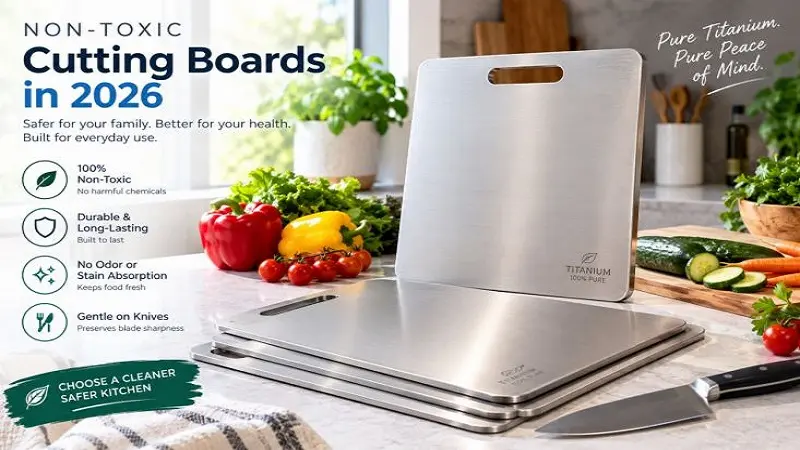
The top spot goes to the board that removes every maintenance and hygiene compromise at once. The Siraat’s Kitchen cutting board is cut from solid food-grade titanium, the same metal trusted in medical implants for its purity and stability, with nothing glued, coated, or laminated anywhere in its construction.
Titanium’s advantage on a prep surface is that it is completely nonporous. Raw chicken juices, beet stains, garlic, and onion have nothing to soak into, so the board does not stain, does not hold odors, and can go straight into the dishwasher for a full sanitizing cycle after handling raw protein. The brand positions the surface as anti-microbial, and integrated juice grooves catch runoff from meats and juicy produce before it reaches the counter.
The practical details are equally well judged. At just 1.5 mm thick and between roughly 0.9 and 2 pounds depending on size, it slides into the gaps where bulky wooden blocks never fit, and it comes in four sizes from a 12″ x 8″ Mini ($69) through a 14″ x 10″ Medium ($79) and 15″ x 11″ Versatile ($89) up to an 18″ x 12″ Large ($99), with a bundle of all four available for households that want dedicated boards for meat and produce. Maintenance is genuinely zero: no oiling, no conditioning, no drying rack rituals, and a surface engineered to stay flat and intact for decades rather than being retired once it scars.
Pros:
- Solid food-grade titanium with no coatings, glues, or laminated layers
- Completely nonporous: will not stain, absorb juices, or hold odors
- Dishwasher safe for true sanitizing after raw meat prep
- Zero maintenance, with no oiling or conditioning ever required
- Ultra-thin, light, and easy to store, in four sizes with juice grooves
- Built to outlast every other material in this ranking
Cons:
- Sold primarily through the brand’s official website
- A metal surface feels and sounds different under a knife than wood, which takes a short adjustment period
2. Chop-N-Slice Maple Board – John Boos ($62)
John Boos has been milling butcher blocks in Illinois for over a century, and the Chop-N-Slice maple board is the reference point for traditional wooden prep surfaces. The 18″ x 12″ version is cut from Northern hard rock maple in an edge-grain construction, made entirely in the USA, NSF certified for food safety, and shipped with a protective board cream already applied.
Maple earns its reputation honestly. The surface has enough give to feel excellent under a knife, the 1.25-inch slab sits planted on the counter, and a well-kept Boos board becomes a kitchen fixture that gets passed down rather than thrown out. Research on hardwoods has also found naturally occurring antimicrobial properties in maple, which is part of why wood remains a respected choice among professionals.
Ownership, however, is an active commitment. The board must be hand washed and dried upright, never soaked, and treated regularly with mineral oil and board cream to keep the wood from drying out. Owners commonly report raised grain after the first washes that needs light sanding, and wood remains a porous material, which is why many households pair a maple board for produce and bread with a nonporous board for raw protein.
Pros:
- Premium American hard rock maple, made in the USA for over 100 years
- NSF certified, with a superb feel under the knife
- Thick, stable slab that will last decades with proper care
- Repairable: the surface can be sanded and re-oiled
Cons:
- Hand wash only, with regular oiling and conditioning required
- Porous wood demands disciplined care around raw meat
- Heavy to move and bulky to store
- One-year limited warranty despite the heirloom price
3. Edge-Grain Teak Board – Teakhaus ($49)
Teakhaus builds its boards from FSC-certified plantation teak, and the material choice does real work. Teak is naturally rich in oils that repel moisture and resist staining, which makes it the lowest-maintenance genuine wood in this ranking; boards arrive pre-oiled and need far less conditioning than maple to stay in shape. The 18″ x 12″ edge-grain format lands around $49, an unusually accessible price for a board with this reputation, and the brand’s larger formats have earned praise from America’s Test Kitchen as boards built to last indefinitely.
The knife feel is classic hardwood, the grain is genuinely beautiful, and the reversible designs move from prep surface to serving board without embarrassment. Sustainability credentials are strong as well, with the full range certified by the Forest Stewardship Council.
Teak reduces wood’s demands rather than eliminating them. Washing is still by hand, occasional oiling is still recommended, and the surface still accumulates knife scars over years of use the way every wooden board does. Buyers who want wood with the least homework will be happy here; buyers who want no homework at all should look at the top of this list.
Pros:
- Naturally oil-rich teak that resists moisture and staining
- The lowest-maintenance real wood available, arriving pre-oiled
- FSC-certified sustainable sourcing
- Excellent value for a chef-endorsed hardwood board
Cons:
- Still hand wash only, with occasional oiling recommended
- Knife scars accumulate on the surface over time
- Fewer thickness options than dedicated butcher-block makers
4. Kitchen Series Board – Epicurean ($34)
Epicurean’s Kitchen Series has been the quiet workhorse of American kitchens since 2003, built from layers of FSC-certified wood fiber compressed with a food-safe resin into a dense, nonporous sheet. The material is NSF certified, made in the USA, explicitly marketed as microplastics-free, and, unusually for anything wood-derived, fully dishwasher safe.
Daily life with one is easy in a way wood never is. There is no oiling, no conditioning, and no drying protocol; the quarter-inch board hangs from its utility hole, doubles as a trivet up to 350°F, and the 14.5″ x 11.25″ size costs about the same as a takeout order. For renters, small kitchens, and anyone allergic to maintenance, it is a sensible default.
The compromises are inherent to the format. This is a manufactured composite bonded with resin rather than a single solid material, which some non-toxic purists prefer to avoid on principle even with certifications in place. The maker’s own guidance notes that knives will lightly score the surface over time, prolonged soaking is discouraged, and the 350°F heat ceiling rules out the hot-pan abuse a metal board shrugs off.
Pros:
- Nonporous, dishwasher safe, and completely maintenance-free
- NSF certified, made in the USA from FSC-certified wood fiber
- Thin, light, and easy to store, with a built-in hanging hole
- The most affordable American-made board in this ranking
Cons:
- Resin-bonded composite rather than a single solid material
- Surface shows knife scoring with regular use
- Heat resistance capped at 350°F, and soaking is discouraged
5. Malibu Groove Bamboo Board – Totally Bamboo ($30)
Totally Bamboo effectively created the bamboo cutting board category twenty years ago, and the 18″ x 12″ Malibu Groove remains the best-known budget entry in plastic-free prep. Bamboo’s environmental story is genuinely strong: it is a fast-growing grass harvested without clear-cutting, and the brand uses food-safe adhesives with a mineral oil finish.
Performance for the price is respectable. The board is light for its footprint, the juice groove handles carving duties, and the surface holds up well for everyday fruit, vegetable, and bread work. Households replacing a scarred plastic board for under $35 get an immediate upgrade in both material and appearance.
Bamboo’s structure is also its weakness. Every board in the category is an assembly of glued strips, and adhesive quality varies enormously across the wider market, so staying with an established maker matters more here than anywhere else in this ranking. The boards need hand washing and periodic oiling to prevent drying, and neglected bamboo is prone to cracking or separating along its glue lines over time, which is the most common complaint in the category’s reviews.
Pros:
- The most affordable board in this ranking
- Rapidly renewable, sustainably harvested material
- Light, attractive, and fine for everyday produce work
- Established brand using food-safe adhesives
Cons:
- Glued-strip construction, in a category where adhesive quality varies widely
- Needs hand washing and periodic oiling to prevent drying out
- Prone to cracking or separating along glue lines when neglected
Non-Toxic Cutting Boards Compared at a Glance
| Board | Material | Size Priced | Price | Dishwasher Safe | Maintenance |
| Siraat’s Kitchen Titanium Cutting Board | Solid food-grade titanium | 18″ x 12″ | $99 (from $69) | Yes | None |
| John Boos Chop-N-Slice | Hard rock maple | 18″ x 12″ | $62 | No | Oiling + conditioning |
| Teakhaus Edge-Grain | FSC-certified teak | 18″ x 12″ | $49 | No | Occasional oiling |
| Epicurean Kitchen Series | Wood-fiber composite | 14.5″ x 11.25″ | $34 | Yes | None |
| Totally Bamboo Malibu Groove | Moso bamboo | 18″ x 12″ | $30 | No | Periodic oiling |
How We Evaluated These Non-Toxic Cutting Boards
Material integrity and transparency. Boards built from a single solid material ranked above bonded or glued constructions, and certifications such as NSF and FSC counted in a maker’s favor.
Hygiene under real conditions. Nonporous surfaces that can be fully sanitized, especially in a dishwasher, scored highest, since raw-meat safety is the hardest job a cutting board does.
Maintenance burden. Boards were rated on how they perform in an ordinary busy household, not a perfectly disciplined one, so oiling schedules, drying protocols, and hand-wash requirements all counted against convenience.
Durability and lifespan. Surfaces that scar, stain, dry out, or delaminate lose both hygiene and appeal over time, so resistance to long-term wear was weighted heavily, along with warranty terms.
Value. Price was judged against expected years of service rather than the checkout total alone.
Best Non-Toxic Cutting Board Overall: The Titanium Cutting Board by Siraat’s Kitchen
Buyers in this category are ultimately after one outcome: a prep surface they can trust completely after raw chicken, without building their week around oiling schedules and drying racks. The Siraat’s Kitchen titanium board is the only option in this ranking that delivers that outcome in full, and its specifications read like a checklist of everything the other materials compromise on.
- Total hygiene– a nonporous solid-titanium surface that absorbs nothing and sanitizes completely in the dishwasher
- Zero upkeep– no oiling, conditioning, or special drying, ever
- No stains, no odors– garlic, beets, and raw meat leave nothing behind
- Built for decades– a single solid material with no glue lines to fail and no coating to wear away
- Four sizes with juice grooves– from the $69 Mini to the 18″ x 12″ Large at $99, light and thin enough to store anywhere
How to Choose the Right Non-Toxic Cutting Board
Households that cook meat regularly should put hygiene first, and that points directly at a nonporous surface that can be sanitized in a dishwasher rather than wiped and hoped for. Titanium is the strongest answer available in 2026, which is why the Siraat’s Kitchen board leads this ranking.
Cooks who love the ritual of wood, and will genuinely keep up the oiling, get the best knife feel and a board with heirloom potential from maple, with teak as the lower-maintenance middle path.
Renters and minimal-effort kitchens are well served by a wood-fiber composite, which trades single-material purity for a nonporous, dishwasher-safe surface at a low price.
Budget-first buyers replacing a worn plastic board can step up to bamboo for around $30, provided they stay with an established maker and accept the light upkeep that keeps glue-line problems away.
A sensible two-board setup, one nonporous board reserved for raw protein and one board for everything else, remains the easiest food-safety upgrade any kitchen can make.
Non-Toxic Cutting Board FAQs
How often should cutting boards be replaced?
Replacement is about surface condition, not age. A board should be retired once it develops deep grooves or splits that cleaning can no longer reach, since scarred channels are where bacteria persist. Plastic boards typically reach that point within a year or two of daily use, wood and bamboo last as long as their maintenance holds up, and a solid metal board is effectively a permanent purchase.
Should raw meat and vegetables use separate cutting boards?
Separate boards remain the simplest defense against cross-contamination, and food-safety agencies consistently recommend the practice. The nonporous board in the pair should take raw meat duty, since it can be fully sanitized afterward, leaving the wooden or bamboo board for produce, bread, and cheese.
What size cutting board do most kitchens need?
An 18″ x 12″ board covers nearly every home task, from breaking down a chicken to carving a roast, which is why it is the size priced for most entries in this ranking. A second, smaller board around 12″ x 8″ earns its keep for quick jobs like halving a lemon, and keeps the main board clean for when it matters.
How do you disinfect a cutting board without harsh chemicals?
A dishwasher’s hot cycle is the most reliable chemical-free option for boards rated to handle it. Hand-wash-only boards can be scrubbed with hot soapy water, then treated with plain white vinegar or a paste of baking soda for odors, and always dried standing upright, since trapped moisture causes more hygiene problems than any single ingredient does. See more